FIELD NOTES BLOG
Why is There Wildfire Smoke in the Midwest?
Over the last week, much of the Midwest experienced the worst air quality it has seen all year, and in some states, in recorded history. Smoke from wildfires far north in Canada and Northern Minnesota blanketed the great lake states, leaving the air thick, dangerous, and smelling like a campfire. Air Quality Index’s (AQI’s) soared over 900 in parts of Minnesota. At times, health experts estimated that breathing the smoky air was comparable to smoking half a pack of cigarettes over the course of a day.
How can a fire so far away affect the air we breathe here in Rockford?
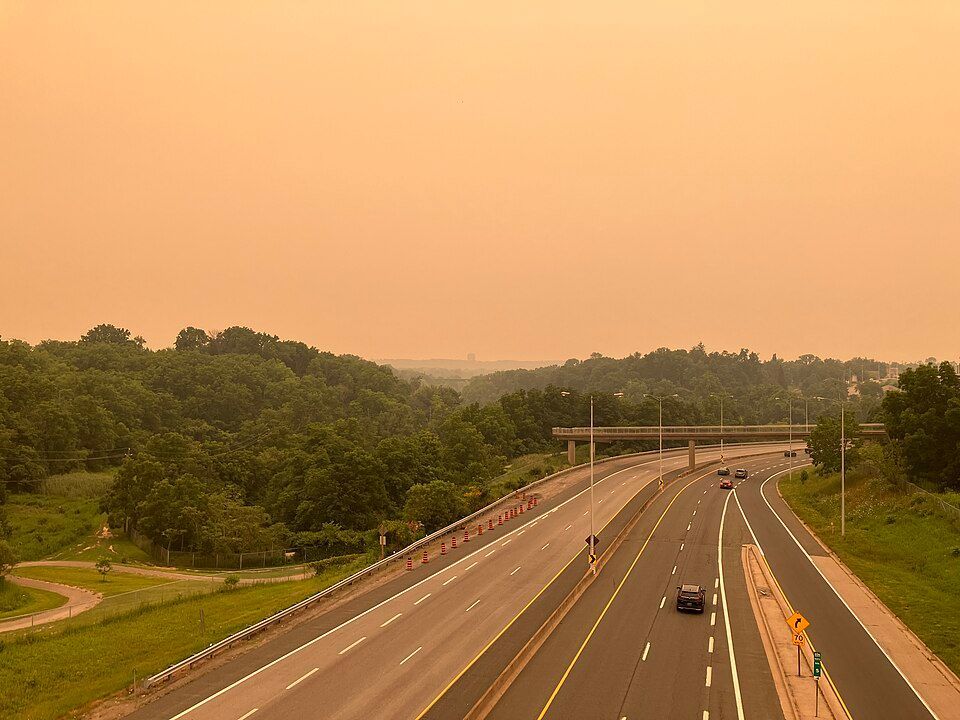
There is no fire in northern Illinois, so why is there smoke?
Wildfires are a natural part of many ecosystems, but the level of fires we are experiencing today are not. Warmer temperatures, prolonged drought, and earlier snowmelt are just a few of the many factors that are creating longer fire seasons across North America. Due to these reasons, forests and grasslands dry out more quickly which allows fires to grow larger and burn hotter than they once did. What’s incredible about these hotter fires is that when they burn this intensely, they can actually create their own weather.
When a wildfire becomes intense like this, the heat rising from the flames can create towering clouds called pyrocumulus clouds that act like giant chimneys. Instead of smoke remaining close to the ground, these powerful updrafts can lift smoke several miles into the atmosphere. Once the smoke reaches those higher altitudes, it can be caught by the jet stream that transports it across the continent. This is why smoke from Canada can end up affecting people hundreds or even thousands of miles away, including us in Rockford.
Effects of a changing jet stream:
One of the biggest players in transporting this smoke is the jet stream. The jet stream is a narrow band of extremely fast winds high in the atmosphere that circles the Northern Hemisphere. Meteorologists often compare it to a river of air because it guides weather systems across North America. Once wildfire smoke reaches the upper atmosphere, the jet stream can carry it astonishing distances. During this particular event, smoke in Canada was swept southward by the jet stream before spreading across the Midwest and Northeast.
However, the jet stream is changing with the climate. The Arctic is warming at a rate much faster than the rest of the planet, which is in turn shrinking the temperature difference between the poles and the equator. This weakens the pressure gradient and causes the jet stream to meander more slowly across the continent in large, swooping paths. As a result, weather systems (like heat domes or smoke) can become stalled and linger over the same regions for days or even weeks.
Effects of a heat dome:
While the jet stream transported the smoke, a heat dome helped keep it here.
A heat dome forms when a large area of high pressure and warm air “parks” over a region, generally linked to the slowing jet stream. Heat domes act like a lid on the atmosphere, and instead of allowing air to rise and mix higher in the atmosphere, it traps the warm air and everything in it close to the ground. During last weekend's event, the heat dome trapped wildfire smoke near the surface. Without strong winds or rain to clear the air, smoke concentrations continued to build, leading to hazardous air quality across much of the Midwest for several days.
Why are we seeing this more often?
The Midwest has often been called America's "climate safety belt." Compared to many other parts of the country, we have abundant freshwater, productive farmland, and relatively low risk from threats such as forest wildfires, hurricanes and coastal flooding. However one thing we're learning is that smoke and air quality are continuing to become a growing threat to our region. In the past, the Midwest rarely dealt with wildfire smoke of this magnitude, but it is now becoming part of the "new normal" for summer weather. This past weekend, the state of Wisconsin even recorded its
highest AQI readings in recorded history. Climate change isn't just increasing wildfire activity where fires occur, it is increasing the chances that communities far from those fires will experience unhealthy air.
Why smoke is more dangerous than it looks:
Wildfire smoke is more than just unpleasant, it’s harmful to your health. The greatest concern comes from tiny particles called PM2.5, which are about 30 times smaller than the width of a human hair. Because they're so small, they can enter the bloodstream. Exposure can cause irritated eyes, coughing, sore throats, headaches, and difficulty breathing. For children, older adults, pregnant people, and individuals with asthma, heart disease, or other respiratory conditions, the health risks can be much more serious.
Researchers estimate that wildfire smoke already contributes to tens of thousands of premature deaths each year worldwide, and that number is expected to rise as wildfire seasons become longer and more intense.
How can you protect yourself?
- Check your local Air Quality Index (AQI) before spending time outdoors.
- Limit strenuous outdoor activities when air quality reaches unhealthy levels.
- Keep windows and doors closed during poor air quality events.
- Run your air conditioner on recirculate or use an air purifier if available.
- If you must be outside for extended periods during heavy smoke, a properly fitted N95 respirator can help reduce exposure.
Wildfire smoke may seem like a problem for western forests or remote parts of Canada, but this weekend showed that its impacts can reach all the way to northern Illinois. As our summers continue to change, understanding how smoke travels, and how to protect ourselves, will become an increasingly important part of living in the Midwest.
For more information on why this fire season is projected to be record breaking, cleck out our
June Climate News
Sources
Canadian Wildland Fire Information System
Link between raging wildfires and climate change is greater than ever - NPR
Wildfire smoke is driving terrible air quality as new wildfire plumes arrive from Canada- CNN
Particulate Matter (PM) Basics - EPA
Deaths From Wildfire Smoke Have Risen Globally- New York Times
DataWatch: Wisconsin air pollution reaches record highs as wildfire smoke engulfs the state- Wisconsin Watch
Dangerous wildfire smoke, record poor air quality choke Minnesota- MPR News
RECENT ARTICLES