FIELD NOTES BLOG
July Climate News: Corn Sweat
Corn does what?
You heard that right. Corn sweats.
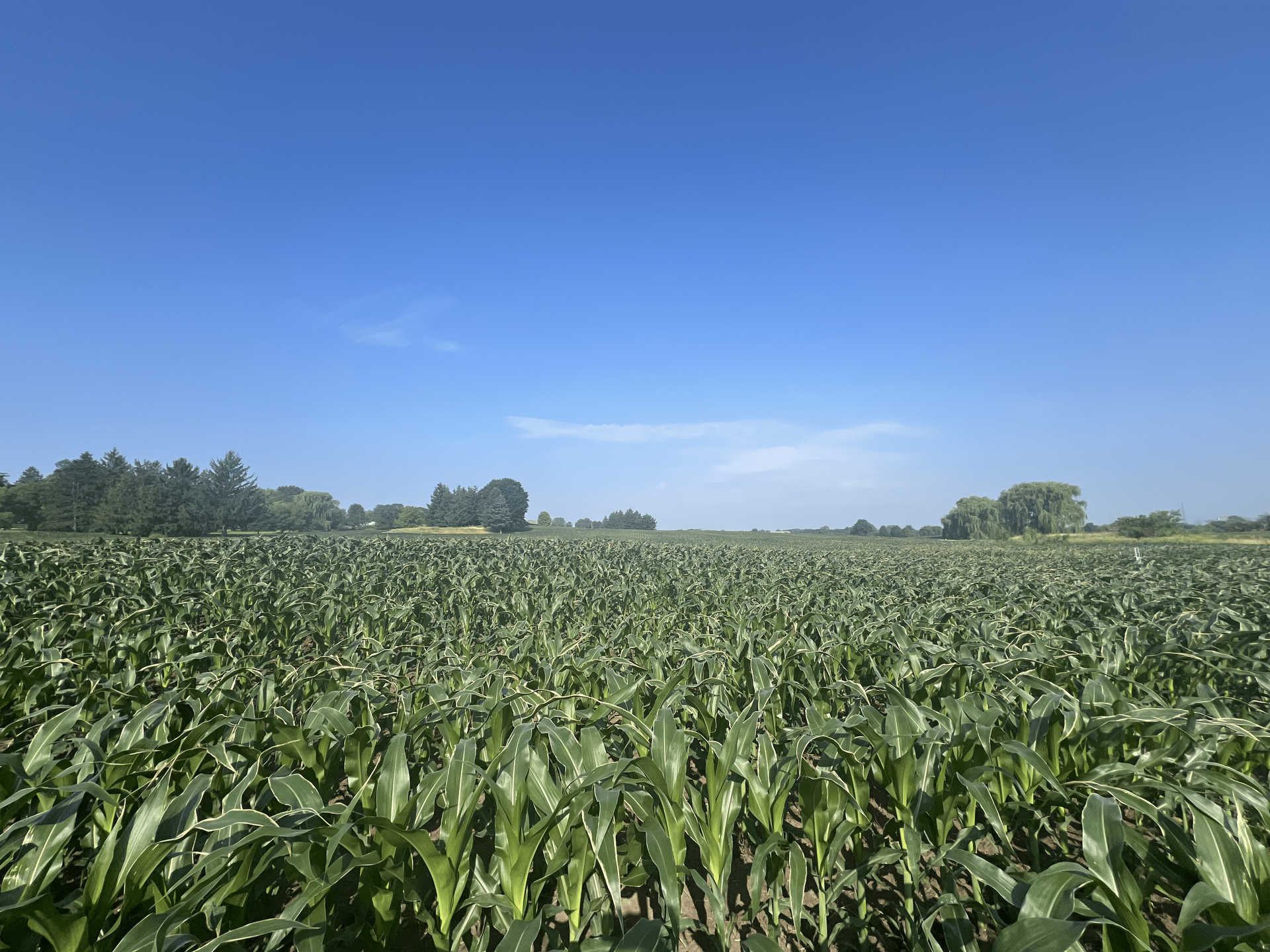
It has been a hot July, and it may be about to feel even hotter. One of the reasons is something maybe you’ve heard mentioned on the weather forecast or buzzing around on social media. Corn sweat. “Corn sweat” is a nickname given to corn’s peak evapotranspiration, which is a natural process that inadvertently makes our summers in the corn belt feel much more humid.
Evapotranspiration combines two processes: evaporation and transpiration. The evaporation part of this process comes from the soil, and the water that evaporates from it as it heats up during the summer. Transpiration, however, comes from the corn plant itself. Corn absorbs water and nutrients from the soil through their roots. That water then travels up the stalk of the corn and into the leaves of the plant, where it is released into the air as water vapor. Together, these two processes working concurrently result in evapotranspiration, or as we lovingly refer to it, corn sweat.
Every plant releases water this way, but we feel the effect of corn because so many acres of it are growing and reaching peak evapotranspiration at the same time. During corn's peak growing stages during their tasseling and flowering stages (usually mid July to early August), a single acre of corn can release up to
4,000 gallons of water vapor into the atmosphere every day. To put that in perspective, that’s about 100 bathtubs full of water! When you multiply that by Illinois’ roughly
93 million acres of corn, it’s easy to see why this process can have such a noticeable effect on our summer weather.
All of that extra moisture in the atmosphere increases humidity throughout the Midwest. Although this higher humidity can sometimes keep actual air temperatures down, it also makes the temperature
feel
much hotter outside. This happens because our bodies cool themselves by evaporating through our sweat. When the air is already saturated with moisture, our sweat evaporates much slower, and makes it harder for our bodies to cool down. To compound this, humid air also holds onto heat during the evening. Without the typical drop in temperatures in the evening, hotter, muggier nights with higher lows become more common.
Research is also finding that corn sweat could be influencing more than just our local weather. Research published in
Geophysical Research Letters found that agricultural intensification across the central United States has contributed to overall increased humidity, cooler daytime temperatures, and more rainfall and thunderstorms. These factors contribute to a feedback loop, because as rainfall increases and saturates the soil, crops have even more water available to release back into the air, resulting in a cycle of rainfall, evapotranspiration, and humidity.
So the next time you step outside and the air feels thick enough to wear, you can thank the corn. As we love to say in the Midwest, it’s not the heat, it’s the humidity.
Sources:
Alter, R. E., Douglas, H. C., Winter, J. M., & Eltahir, E. A. B. 2018. Twentieth century regional climate change during the summer in the central United States attributed to agricultural intensification. Geophysical Research Letters, 45, 1586–1594. https://doi.org/10.1002/2017GL075604
Friend, D. 2021. How does corn affect Midwest weather? Illinois Extension. University of Illinois Urbana-Champaign.
https://extension.illinois.edu/blogs/all-about-weather/2021-07-15-how-does-corn-affect-midwest-weather
Wilson, A.B., Lindsey, A., and Ortez, O. 2024. Corn sweat and humidity: A few facts explained. OSU Extension. The Ohio State University.
https://extension.osu.edu/about/resources/corn-sweat-and-humidity-few-facts-explained
RECENT ARTICLES