FIELD NOTES BLOG
The Potential Slowdown or Shutdown of AMOC, the Atlantic Meridional Overturning Circulation
The ocean, and all of the water in it, is constantly in motion. Though it may sometimes appear calm on the surface, enormous currents continuously move ocean water around the globe like a giant conveyor belt. These currents regulate weather, move nutrients across ecosystems, and shape the climates of entire continents.
Currents on the surface of the ocean are controlled by the wind, but deeper in the ocean currents are controlled by water density in a process known as
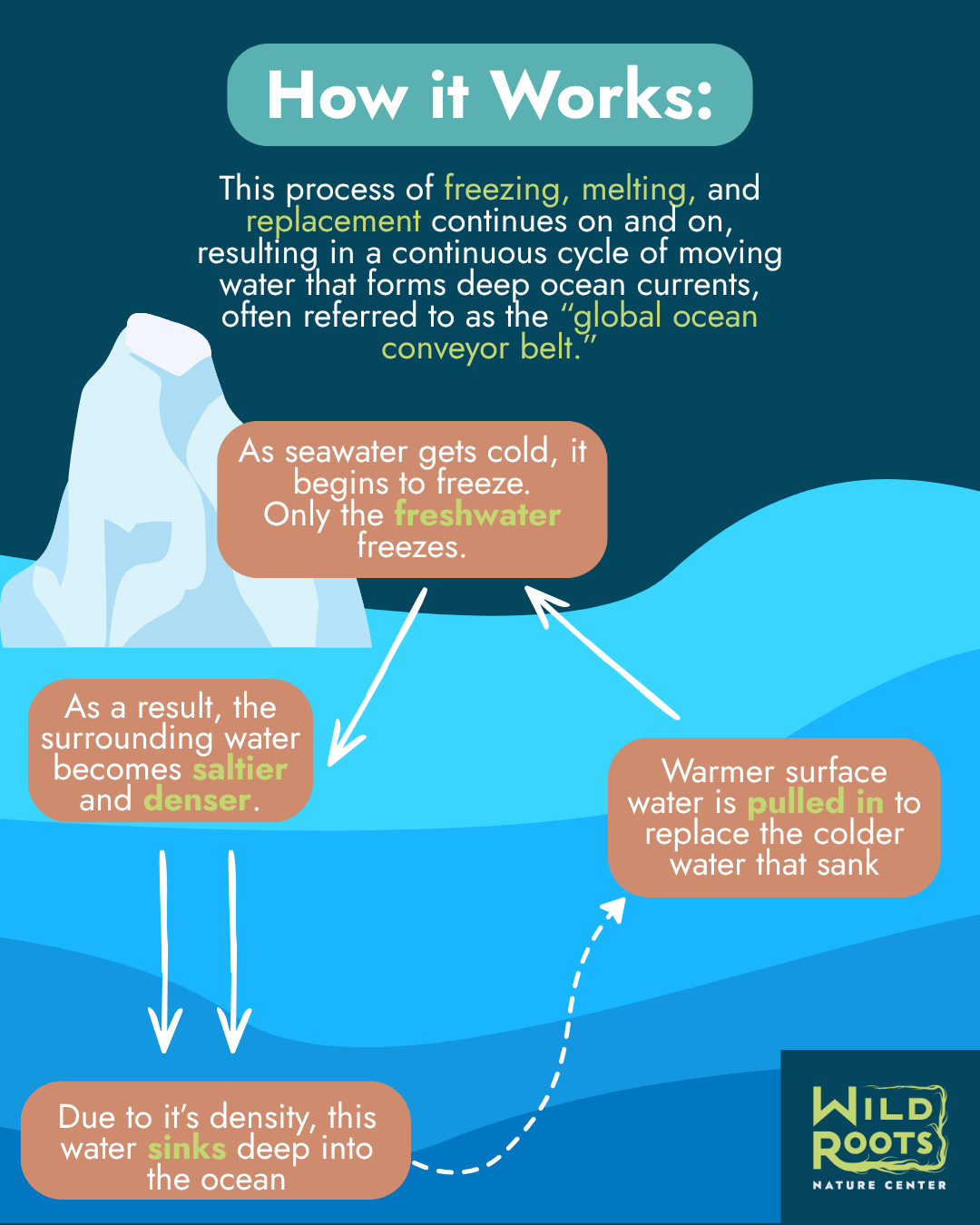
thermohaline circulation. Thermohaline refers to the temperature (thermo) and salinity, or saltiness, (haline) of the water. Circulation refers to how the water moves throughout the ocean from pole to pole. Though this is a complicated sounding word, the process is actually pretty simple. Here’s how it works:
As ocean water travels toward the poles it becomes colder, and when it gets cold enough, it eventually begins to freeze and forms into sea ice. What is important about this process is that when seawater freezes, the salt is left behind in the surrounding water. As a result, the surrounding water becomes saltier, colder, and in turn becomes more dense than the water around it. Eventually, this water becomes dense enough to sink deep into the ocean, and warmer surface water moves in to replace it. This process of freezing, melting, and replacement continues on and on, resulting in a continuous cycle of moving water that forms deep ocean currents, often referred to as the “global ocean conveyor belt.”
What is AMOC?
One deep ocean current that has been getting a lot of attention recently is the
Atlantic Meridional Overturning Circulation, or AMOC for short. AMOC acts as the giant conveyor belt of the Atlantic Ocean, circulating water from north to south and back in a long cycle. AMOC begins off the coast of Greenland, where cold, dense water sinks, pulling the warmer surface waters from the east coast of the Americas towards northern Europe. This circulation plays a critical role in regulating global climate, especially in Europe.
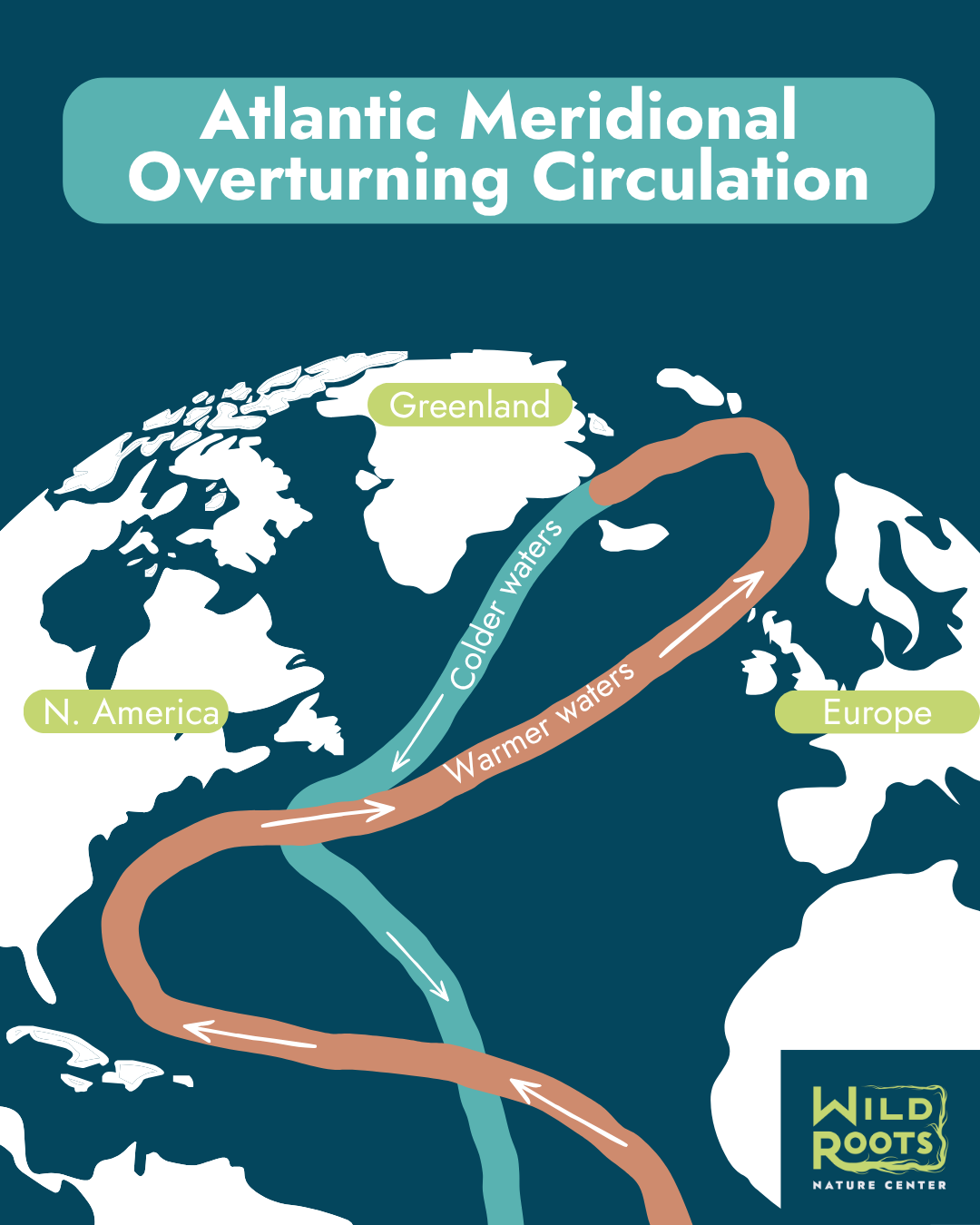
Have you ever wondered why many European cities have a more temperate climate than North American cities at a similar latitude? For example, London (UK) and Calgary (CA) are two cities that are on the same parallel, meaning they are an equal distance from the equator. However, London has far milder winters than Calgary. This is thanks to AMOC. The AMOC redistributes warm water from the tropics of the gulf all the way up to the Norwegian Sea. Without it, many parts of Europe would have a much colder climate.
AMOC is slow, and takes about 1,000 years for any one drop of water to complete the cycle. However, scientists are warning that it’s slowing down. This is happening because the mechanics that power AMOC, the freezing and sinking, are slowing, and this is happening for a few reasons.
The Effects of a Warming Ocean on AMOC
If we recall, AMOC begins off the coast of Greenland. Greenland is the second-largest ice body in the world (after Antarctica) and holds about 7% of Earth's total freshwater reserves in the Greenland Ice Sheet. Approximately 80% of Greenland’s landmass is covered by the massive Greenland Ice Sheet. The issue is that this ice sheet is melting, and it’s melting fast. Between 2002 and 2025, Greenland lost approximately 264 gigatons of ice per year, causing global sea level to rise by 0.03 inches per year. This number is really challenging to understand, so to put that in perspective, this is about the equivalent of Greenland losing about 3 Olympic swimming pools of freshwater every second. This is concerning because the Greenland Ice Sheet melting is the second largest contributor to sea level rise, following thermal expansion of warming water. Both of these issues, though, are caused by the same thing: human-caused changes to the environment.
This is concerning regarding AMOC, because as we have previously discussed, freshwater is less dense than saltwater. This enormous amount of freshwater that is being dumped into the ocean from melting ice creates a buoyant layer on the surface of the ocean that prevents the water from sinking. On top of this, rising global temperatures are heating the surface waters of the ocean. Since 1950, the average ocean temperature has risen by
2.61°F (1.45°C). Warm water is lighter and less dense than cold water, which further inhibits the water's ability to sink into the deep sea.
The Potential of An AMOC Slowdown (or Shutdown):
Because AMOC is powered by the sinking of cold, dense water, this effectively slows, and potentially even stops, AMOC. The shutdown of AMOC has happened before, roughly 12,000 years ago at the end of the last Ice Age when huge amounts of fresh water melted into the northern oceans. This sent much of Europe back into ice-age-like conditions, with Greenland, for example, cooling by 18°F (10°C). Now, scientists are predicting a similar shutdown, with studies suggesting AMOC is more likely than not to collapse by 2050.
AMOC has slowed down by about
15% since the 1950s. In November of last year,
Iceland became the first country to declare the shutdown of AMOC a national security threat, and other European countries have increased their funding for AMOC research. And while how much it has slowed down, and how much it may slow down, is still debated, the consensus is that the warming ocean is likely to further weaken the AMOC.
Regardless of whether we experience a total shutdown of AMOC, or just a slowdown, there will be effects felt across the globe. Predicted
results of a slowdown would include “cooling Europe, and changing precipitation patterns in parts of Europe, South America, and Africa. In addition, a slowdown of AMOC would change the timing of the Indian monsoon season and would shift the entirety of the tropical rain belt southward, resulting in droughts over the African Sahel.” If there was a complete shutdown of the AMOC,
researchers state that “changing currents would cause sea levels to rise swiftly in areas like the U.S. East Coast, storms would grow more severe, the rainy and dry seasons in the Amazon may flip, and the ice age pattern of a cooling north and warming south would play out once again.”
Whether AMOC shuts down, or just slows, it will affect the globe in many vital ways. To rest assured that AMOC will continue to power the Atlantic, we need to take action. The sooner we are able to shift our world economy and our way of living towards a climate-neutral model, and slow the warming of the world, the more security we will all have. Not just here at home, but across the entire globe.
Sources:
What is the Atlantic Meridional Overturning Circulation (AMOC)? - NOAA
Reconstruction of Major North Atlantic Circulation System Shows Weakening - NOAA
Why Fears Are Growing Over the Fate of a Key Atlantic Current - Yale Environment 360
Greenland Ice Mass Loss 2002-2025 - NASA
Ocean Warming - Earth Indicator - NASA
What would happen if the Atlantic Meridional Overturning Circulation (AMOC) collapses? How likely is it? - MIT Climate Portal
European & North American Cities Transposed Onto The Opposite Continent At The Same Latitude - Brilliant Maps
RECENT ARTICLES