FIELD NOTES BLOG
Tick-tock: It’s Tick Time
As much as we love seeing spring ephemerals pop up early, the startlingly warm temperatures so far this year come with another, less welcome, spring staple: ticks. This year’s mild winter and early spring are laying the groundwork for a thriving tick population, which is not necessarily good news for hikers. Luckily, researchers have found a way to keep tick numbers in check by doing something that many of our local land managers are already doing!
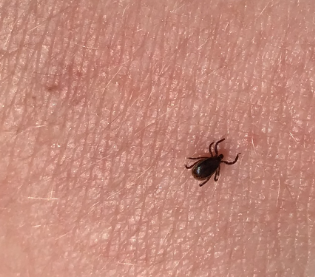
Eastern black-legged tick. April 2023
But, before we dive into the ways we can keep ticks from becoming a major public health issue, let’s review why we seem to see so many ticks nowadays. Here at Severson, we’ve already started seeing some Eastern Black-legged Ticks (Ixodes scapularis) this year, which is much earlier than normal. According to iNaturalist records between 2018 and 2024, the earliest we usually start seeing ticks in Winnebago County is about March 20th. This year, however, the first confirmed tick sighting occurred on February 8th- a full month and a half earlier!
To understand why there seem to be more ticks today than in previous decades, we have to look at the two main drivers of tick populations: habitat and hosts. Ticks need habitats that can protect them from drying out and keep their surrounding temperatures mild. Things like drought, extreme cold, and extreme heat can be deadly to ticks, so they look for more insulated places to call home.
Luckily for ticks, forest management “best-practices” for the last 200-or-so years has created a plethora of these moist, insulated habitats in the form of leaf litter. Researchers and forest managers refer to this time period as the fire-suppression era because it starkly contrasts the previous 5,000 years of Indigenous forest management that included periodic planned burns in forests across the continent. Whereas, historically, leaf litter would have been burned every few decades (thereby eliminating the moist, insulated habitat that ticks rely on), by intentionally excluding fire from the landscape since the 1800’s, we have allowed a dense layer of leaves, decaying wood, and brush to develop in many of our forests. This plant litter not only holds in moisture that protects ticks from drought conditions, but it also insulates the soil level during cold winters and hot summers to provide milder temperatures year-round.
Beyond providing the perfect shelter for the ticks themselves, fire-suppression practices also encouraged population growth in many of the major host animals that ticks feed from. Dense trees and bushes within a forest creates safe areas for small rodents like mice and chipmunks. That, combined with the forest fragmentation and over-hunting, which greatly reduced many natural predators (bobcats, cougars, etc.) of these rodents, allowed host populations to soar in recent decades. More food (host animals) + more habitat (leaf litter) = more ticks! And more ticks often increases the spread of tick-borne diseases like Lyme Disease and anaplasmosis.
Fortunately, more and more research is coming out about how we can keep tick populations in check, and one of the most effective strategies involves something many forest managers are already doing: prescribed burns! Land managers across the country are putting an end to the fire-suppression era by returning controlled burns to the landscape. These burns are carefully conducted by trained “burn crew” members to ensure that the fire doesn’t get too hot or spread anywhere we don’t want it.
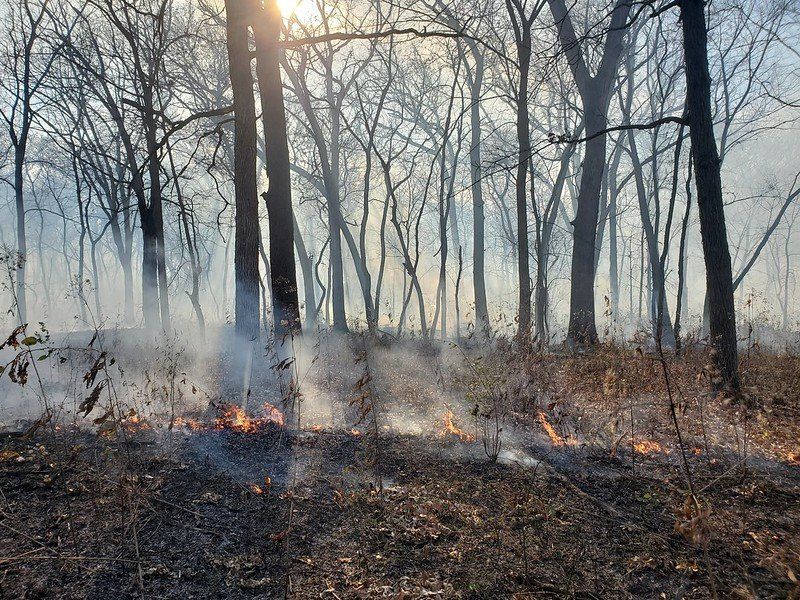
A controlled burn at severson dells from 2021.
Burning is a great way to control invasive plant species, mitigate the risk of wildfires, and prevent forests from encroaching into prairies, and we’re also learning that controlled burns do a great job of clearing out tick habitat! Not only will any ticks that happen to be out and about at burn time get sizzled, but without a dense layer of leaves and decaying wood to keep them insulated from drought and extreme temperatures, any surviving ticks have a harder time living through the winter and summer. It can also remove a lot of the shrub layer of a forest, leaving host animals like rodents more vulnerable to predation, which will potentially decrease their populations. Less food + less habitat = fewer ticks!
The even better news for us is that most local land managers are already using controlled burns on their properties! The Rockford Park District, Natural Land Institute, and Forest Preserves of Winnebago County each conduct burns in the spring and/or fall to give our local natural areas all of the great benefits of fire. Unfortunately, constraints like weather conditions, staff availability, and funding often limit how many acres we can burn each season, but everyone is doing the best they can! And with luck, all this evidence supporting the benefits of fire will encourage more and more people to prioritize controlled burns in their natural areas. The landscape will appreciate it, and we may get the added benefit of fewer ticks to worry about while enjoying a hike!

RECENT ARTICLES