FIELD NOTES BLOG
Spring Wildflowers
April showers bring May flowers… and they're already beginning to appear! These newly emerging wildflowers remind us that the season is changing and that soon the lands around us will be in full bloom. With all of the excitement, let’s dive into some of the things that make flowers so incredible! In this month’s blog, we’ll be learning how to ID wildflowers, talk about the shape and arrangement of certain flowers, their benefits to wildlife, and lastly about their colors and anatomy!
Wildflower ID:
By Caedyn Wells
Identifying plants, especially flowers can be daunting and overwhelming when starting out. To our luck, plants have some key features that help us distinguish them.
Leaf Arrangement
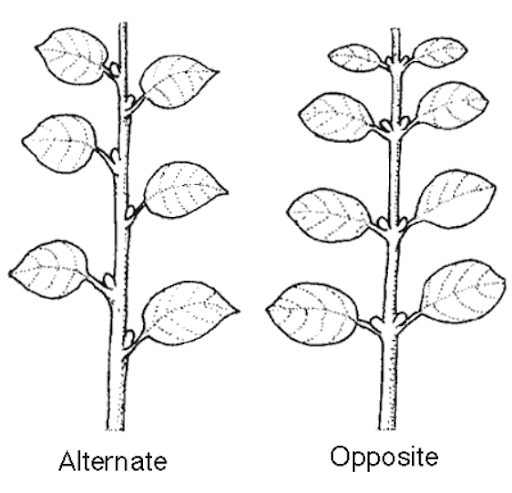
Our first key feature to note when identifying flowers involves looking closer at the plant's leaf arrangement, often categorized as opposite vs alternate. Opposite arrangements have two stems branching outwards from each other in a Y shape, while alternate arrangements instead have branches rotating opposite sides up the stem.
Leaf Shape
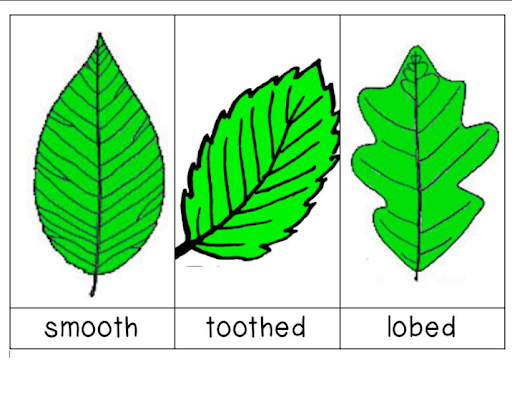
Shapes of the plant's leaves additionally help during identification. These shapes fall into 3 categories: toothed, lobbed, and smooth.
- Toothed: Pointed or jagged with serrated edges
- Lobed: Pointed with round smooth edges
- Smooth: Having a singular smooth blade
Flower Color and Structure
Color also plays a major role in helping us distinguish between species. Color isn't always a reliable identifier though, as color can vary within the same species of flower based on environmental and genetic factors. This is why it can be helpful to look closer at a flower's structure. Structures of flower petals are important indicators when identifying them. Flowers are often arranged into two groups called dicots (flowers with groups of 4 to 5 petals) and monocots (flowers with groups of 3 petals). Looking at an accessible physical difference can help us narrow down species with more ease.
Flower Shape and Arrangement:
By Olivia Price
A flower is the part of some plants that allows them to reproduce. More specifically, flowers are the reproductive structures of plants called angiosperms, which are plants that reproduce by making fruit (app. 80% of all green plants are angiosperms!). A fruit is essentially the fully developed internal reproductive part of a flower.
On flowers, the petals are a kind of modified leaf which help to protect the internal reproductive organs of a flower and to attract pollinators that can aid fertilization of the “eggs” stored in these reproductive organs.
Some flowers grow in solitary arrangements, with just one flower coming off of one stem. Sometimes when we look at a flower, though, we may actually be looking at many
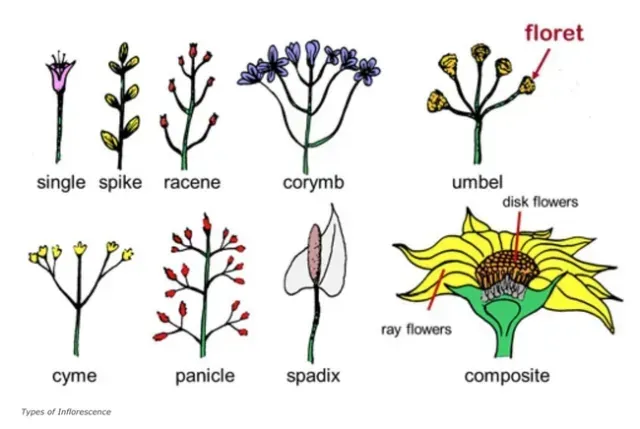
flowers. In angiosperm plants, the amount of and manner in which their flowers are arranged are referred to as their inflorescence.
For example, the regionally native purple coneflower has something called a
composite inflorescence. Although it may look like one large flower, it is actually made up of a bunch of smaller flowers, or
florets. Each petal-like structure on a purple cone flower is one individual flower called a
ray floret, and the top dome-shaped “disc” is made up of many small
disc florets. All of these florets or small flowers together on the stem (or peduncle) make up the inflorescence. Many other types of inflorescences are pictured
here.
There are many other characteristics of flower form to classify, including habit (the way a flower hangs), petal arrangement, shape, color, etc. All of these variable features of flowering plants make them unique members of their ecosystems.
Sources:
University of Illinois Urbana Champaign- Digital Flowers
The Seed Collection- A Brief Guide to Different Flower Types, Shapes, and Growing Patterns
Friends of Flowers: benefits to wildlife
By Lauren Bonavia
In the spring and summer, wildflower nectar feed insects and birds that double as pollinators as they stop at each flower for meals. Some animals rely on nutrient dense-buds, leaves, or roots for food, too. After the blooms are gone, the seeds and other fruit left behind are important food for small mammals, rodents, and songbirds. Seed producing purple coneflowers are one example of important winter forage when not much else is available - think of it as nature’s birdfeeder!
If we shrunk down the size of a shrew, the prairie grasses, wildflowers, and leaf litter would provide excellent cover from becoming a hungry raptor’s lunch, and we would see a city teeming with insects, microscopic life, and other soil-inhabiting organisms. This miniature canopy layer provides pockets of shade and cool in the beating sun (think
heat islands
and how trees shade and cool urban areas). Over winter dormancy, pollinators sleep and lay eggs in native plant stems, so this is a good reason to leave your dead flowers in the wintertime! Leave your leaves, yard waste, and other spring cleaning tasks until the temperature is steadily above 50 degrees F.
Native berries, nuts, and other flowering and fruiting plants provide wildlife food with high nutritional value. Invasive or non-native plants tend to be tasty to animals, but have very little health benefits compared to native forage. Native plants and animals have developed together over time and are built for each other anatomically and biologically. We can’t have one without the other.
This is paragraph text. Click it or hit the Manage Text button to change the font, color, size, format, and more. To set up site-wide paragraph and title styles, go to Site Theme.
Anatomy of a Flower and Why they have Colors:
By Caroline Pacheco
There are 2 major classifications for plants: angiosperms and gymnosperms. Angiosperms are flowering plants, and they are the largest and most diverse group in the plant kingdom. Flowers are the structure where plant reproduction occurs. To reproduce, many flowers require pollination. Sometimes they need the aid of pollinators for pollination, so flowers make sure to ‘dress’ for the occasion. Pretty to admire, flowers have evolved over time to attract the ideal pollinator. Everything from the scent, color, shape, and size of flowers is specially crafted. These are called “pollinator syndromes”.
Not every animal can see the same colors, and flowers take advantage of this. Bees and butterflies look for bright colors, bees look for white, yellow, blue, or even ultraviolet and butterflies land on flowers with bright purples and reds. Nocturnal pollinators, like bats and moths, are drawn to pale colored petals, obvious in the darkness, and are swayed more towards heavily scented flowers. As the pollinators fertilize the wildflowers they are rewarded with nectar.
Flowers are far more than what meets the eye! To learn more about wildflowers, and to see what is in peak bloom, join us for our wildflower walkabouts! From April to June, Severson Dells and Natural Land Institute staff lead exploration of many of the local wildflower hotspots. Wildflower Walks showcase what is currently in bloom at various woodland and prairie preserves around Winnebago, Boone, and Ogle Counties. All walks will begin at 6:00 p.m. There is no fee for the walks, but membership in Severson Dells and/or the Natural Land Institute is encouraged.
RECENT ARTICLES