FIELD NOTES BLOG

The Power of Prairie Roots
education2.americorps
February 18, 2026

Have you ever looked around and wondered about grass? It may not seem like there’s much to notice about the common golf course, front lawn, sidewalk adjacent sort of grass we see everyday, but if you look below the surface there’s a whole world and history.


These often monochromatic, sprawling green landscapes are planted with what is referred to as turf grass, such as Kentucky blue grass, a plant imported to the United States from Europe and North Africa. This style of lawn design was brought to the U.S. from Europe during the 1700s, where long expanses of short green grasses were associated with the manicured country estates of the wealthy and upper social classes. The popularization of this cultural import co-occurred and played a role in the development of U.S. suburban culture in the late 1800s, strengthening through the mid-20th century when it became more widely actionable for people in the middle class. Turf grass now covers app. 40 million acres across the country(an area larger than the whole of Illinois).


The planting of monoculture grass areas like this, where there are long stretches of only one kind of plant, came in contrast to the landscapes that grew for millenia on the place we now call the United States. These ancient landscapes were full of biodiversity, and in many areas housed ecosystems where humans functioned as just one part of a balanced set of biological processes. 


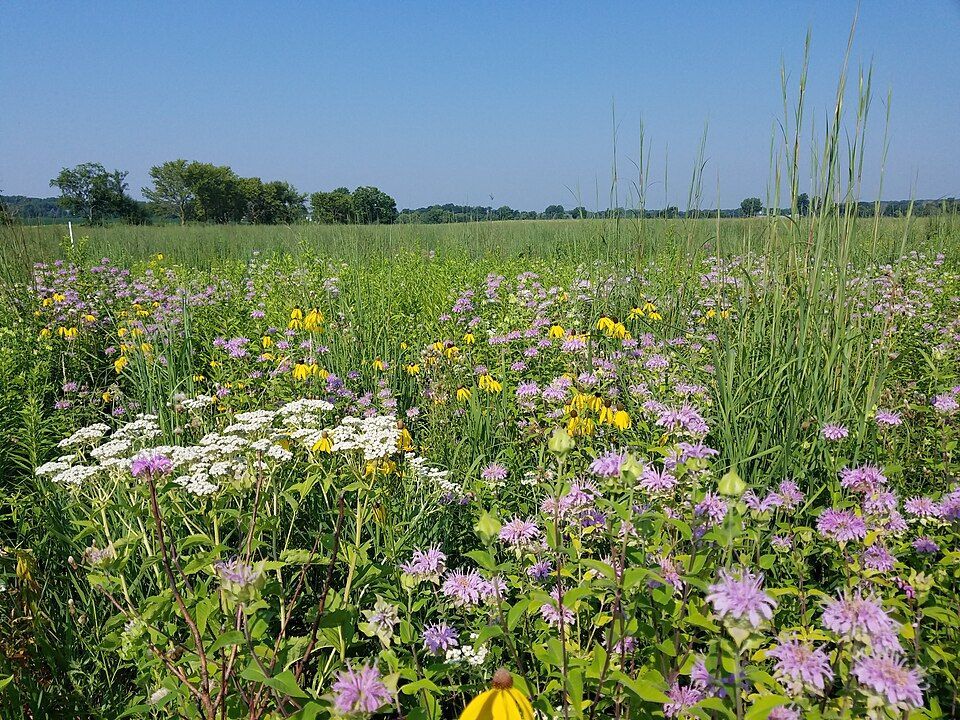
In Illinois specifically, native grasslands–in this region called prairies–used to cover 21 of Illinois’ 36 million acres on their own. Prairies in Illinois formed (and the .01% that still remain still form) unique and powerful living systems. Not only do they create a safe home for many animal species to go about their lives, their root systems push through soil to notable depths, with an average length between 5-15 feet, whereas the turf grass lawns discussed above have roots not digging more than 3-4 inches into the earth. The impact of these root systems is profound, creating long pathways for water absorption, microbial and mycelial growth, and the draw down of excess carbon from the atmosphere back into the earth. One acre of restored prairie can sequester(take out of the air and store in root systems) 1 ton of carbon a year, and absorb 65% more stormwater–or water left on the ground after it rains–than turf grass. 


The transformation of turf grass back to prairie has profound positive impacts on surrounding ecosystems. The restoration project at
Elliot golf course will provide a prime example for residents of this region to watch as the land begins to come alive with the myriad colors, animals, and landscape benefits of a prairie in just a few years. 


Sources:

https://www.sustainablewoodstock.org/a-history-of-the-american-lawn/ 

https://blog.nwf.org/2024/04/why-we-have-lawns/ 

https://www.fs.usda.gov/r09/midewin/natural-resources/forest-management 

https://www.chicagobotanic.org/blog/plant-science-conservation/lowdown-prairie

https://www.chicago.gov/city/en/depts/water/supp_info/conservation/green_design/natural_landscaping.html

https://files.dnr.state.mn.us/assistance/nrplanning/community/roadsidesforwildlife/putdownroots_poster.pdf 

https://www.onlyraindownthedrain.com/kids/ 

https://www.nature.com/articles/s41467-024-46991-5?fromPaywallRec=false



RECENT ARTICLES
By Holly Hansen July 9, 2026
While many of you may already know me, allow me to introduce myself! I’m Holly and I’m the new community engagement manager here at Wild Roots Nature Center . While I am new to this role, I am not new to Wild Roots. I got my start at Wild Roots way back in 2019 as an environmental education AmeriCorps Volunteer. During my time, I was able to help connect people to nature and foster stewardship of our lands at all age levels. Even when COVID-19 hit, that didn’t stop us from planning for the future and coming up with ideas for how to engage people in our natural world. From there, I completed two more terms of service with AmeriCorps, one in Florida and one back here at Wild Roots with 815 Outside. (You’ll start to notice a pattern here.) As I finished my undergraduate degree in environmental studies and my master’s degree in higher education and student affairs, I remained a volunteer with Wild Roots, joining in on the fun of Science Saturdays, signature events like Luminaria, and canoe convoys. I simply never left this community. My most recent role as assistant director of campus sustainability at Northern Illinois University has prepared me for my return to Wild Roots. I’ve learned so much over the years about connecting with people of all different backgrounds, bridging the gap between nature and community. I look forward to continuing these conversations as the community engagement manager at Wild Roots Nature Center! Other fun facts: When I’m not in nature, you can find me among a circle of friends, crafting and laughing, making stained glass art, and immersing myself in a good book or tv show. I’m always happy to be a listening ear and I am fiercely loyal. Plus, I’ll never say no to a new adventure!
By Brandy Korth July 2, 2026
If there’s one thing you should know about me, it’s that I genuinely love people, organized chaos and finding joy in the little things. So, when the opportunity came to join the team at Wild Roots, it felt like everything came together in the best way. Professionally, I’ve spent more years than I’d like to admit in finance, bookkeeping and office management. I actually enjoy spreadsheets, balancing budgets, and making sure all of the behind-the-scenes pieces fit together (yes…I’m one of those people!). But my energetic and bubbly personality doesn’t always fit the type for an accounting aficionado. Before building my career in finance, I earned a degree in Elementary Education. Looking back, it makes perfect sense because teaching and finance have one thing in common – you need patience, flexibility, quick on your feet, and a good sense of humor! I absolutely love the fact that Wild Roots is so committed to outdoor education, and it is one of the biggest reasons I wanted to root myself here as well. Perfect blend of both of my worlds. Outside of work, I’m a proud mom to three wonderful (and very energetic!) boys. They keep me on my toes, whether we’re at a ball field, exploring a new park, or simply enjoying time together. Being their mom has taught me that the best adventures don’t have to be big – they’re usually found in the simple moments, especially when you’re outside exploring together! That’s one of the reasons Wild Roots already feels like the perfect place. I believe nature has an incredible way of bringing people together, slowing us down, and reminding us to appreciate the world around us. Knowing that I get to support an organization that helps families, students and our community experience that every day is something I am truly excited about.  I’m incredibly grateful to be here and can’t wait to be part of everything that makes this place so special. Here’s to new beginnings, new connections, and plenty of time spent enjoying the beauty of nature together!
By Becca Rankins June 25, 2026
This article has been adapted from it's original publication in "Notes From the Dells" Vol 47 No. 1