FIELD NOTES BLOG
October Bird Blog
As almost every avid birder and hunter knows, October is the month of waterfowl. This is because it's around this time of the year where a majority of the species of ducks, geese, and swans begin to leave their breeding grounds in the northern latitudes for places warmer in the southern latitudes. Illinois is a great locale to witness this as we not only sit directly in between the lush breeding grounds of Canada and the Gulf Coast, but we are also a part of the great Mississippi flyway which is host to some of the largest waterfowl migrations in the world. This is coupled with the fact that Rockford specifically is still relatively close to the Great Lakes, which serve as an important stopover for most species. Fall migration is even larger than the spring migration since the flocks of birds are flush with the young birds on their first migrations. So you can count this blog as a waterfowl special as all of the birds we will be covering this time are gonna be waterfowl you might catch flying overhead or spending time at your local water body.
Hooded Merganser
Lophodytes cucullatus
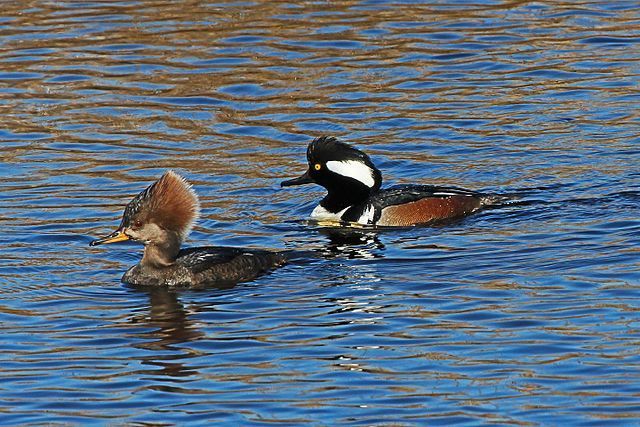
Fall is a great time to catch a glimpse of this species of duck because unlike the other species on this list we actually have a year-round resident population of hooded mergansers. Come fall the migratory populations of Canada begin to pass down which drastically increases the number of birds present here. They are the smallest species of merganser in the United States and the second smallest in the entire world; only about 1 - 2 pounds in weight and having a 2-foot wingspan. Like all other mergansers they are piscivorous, meaning they eat fish, to help with this diet their beaks aren't very duck-like but instead are skinny, serrated and end in a hook. Males are ornate and strikingly patterned, they have a black body, white veins on their wing feathers, reddish brown flanks, and white breast feathers. Females are brown over most of their body though the breast is lighter than the flank and head. Their wings and back are a more gray-brown color. Both sexes have head crests, giving them their “hooded” title, the crests of the males are black but have huge white patches on both sides and the female’s crest is a reddish-brown. The wing speculum of the species is white and black, like an inside-out Oreo. Mergansers are a common sight in small ponds and rivers as they are filled with minnows and crayfish, so areas such as the rock and kish tributaries and the ponds of local municipal parks would be good places to look for them. Although they are usually silent, hooded mergansers make noises during courtship and near their nests. When a male is pursuing, it produces a deep, rolling sound similar to a pickerel frog's call, which gives it the Georgian nickname "frog-duck." When courting, females make a hoarse gack call. The rough croo-croo-crook that females use to call to newly hatched ducklings or while in flight is akin to that of many sea ducks.
Northern Shoveler
Spatula clypeata
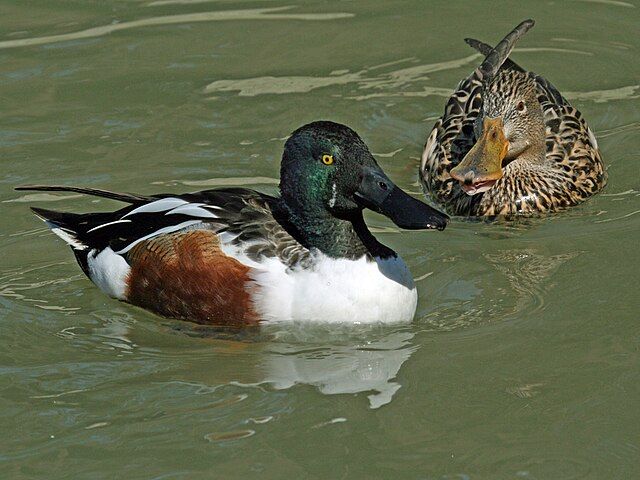
The first and only dabbling duck, a duck that tips over and places its head into the water and it's rump up, we’ll be covering today. Its dabbling prowess is brought upon by its distinctive large, spoon-shaped bill. They have long, thick bristles along the protrusion on the bill that let them easily filter through the water for aquatic seeds and tiny crustaceans. Females look similar to a wide variety of other female dabbling ducks such as the mallard, black duck, and mottled duck. The only real difference to tell them apart from the females of the other species is the bill shape and the blue pastel blue, white, and green patterning on the wing. Males have a blocky coloration pattern with the head being iridescent green, the body being white, the flanks reddish-brown,and the wings, back and rump being a dark brown-black color. Males have a black bill, unlike the female’s yellow one but they still possess the same wing coloration. During the fall and winter months Wildlife Refuges and state parks are an excellent location to search for Northern Shovelers during their migration. Search the edges of shallow water for flocks of ducks that are concentrating on their feeding. You might also find them in smaller, murkier pools of water because they prefer to use stagnant pools of water. Their call is quite quiet and is a raspy “took-took” that is said in quick succession. Females let out a mallard-like quack, but are more raspy.
Red-breasted Merganser
Mergus serrator
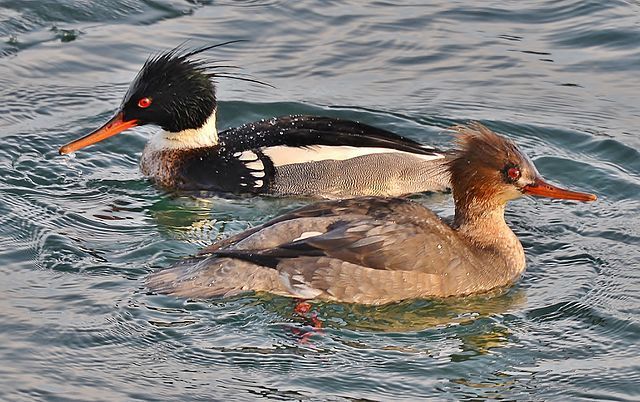
Its name in Latin translates to water bird sawyer. Clearly, the forest part of its name comes from the fact that like all other ducks the merganser is most at home in the water, specifically it loves large lakes and the coastlines. The second part of its name comes from its bill which is similar in shape and function to that of the hooded merganser with it being thin and hooked. However, the serrated teeth-like protrusion on the bill are more numerous and distinct on the red-breasted, giving the appearance of a woodman’s saw. Surprisingly even though both sexes look distinct, both are quite colorful. Males have a strange assortment of colors and patterns. Firstly their heads are jet black save for their bright red eyes and bill; possessing a scraggly crest of feathers. Under the head is a white collar around the neck and the titular red breast. Their back and wings are jet black save for a white tripe located on the flight feathers. The flanks of the bird are a mottled black, gray, and white like that of a scaup or ring-necked duck. Females have a red-brown head with matching crest and the same red bill as the males but lack the red eyes. The rest of their body is a mottled gray. Of the five birds covered today, this species will be the hardest to get your binoculars on as they don't spend much time here only stopping over to sleep, drink, and eat as a recharge on time journey to the Gulf of Mexico. Your best bet might be to travel outside of Rockford to the Chicago area to catch them on Lake Michigan or test your luck at one of the local wetlands. Males meow like cats while females make a raspy or croaking noise. Females grunt harshly when in flight. Red-breasted Mergansers are usually silent otherwise.
Canvasback
Aythya valisineria
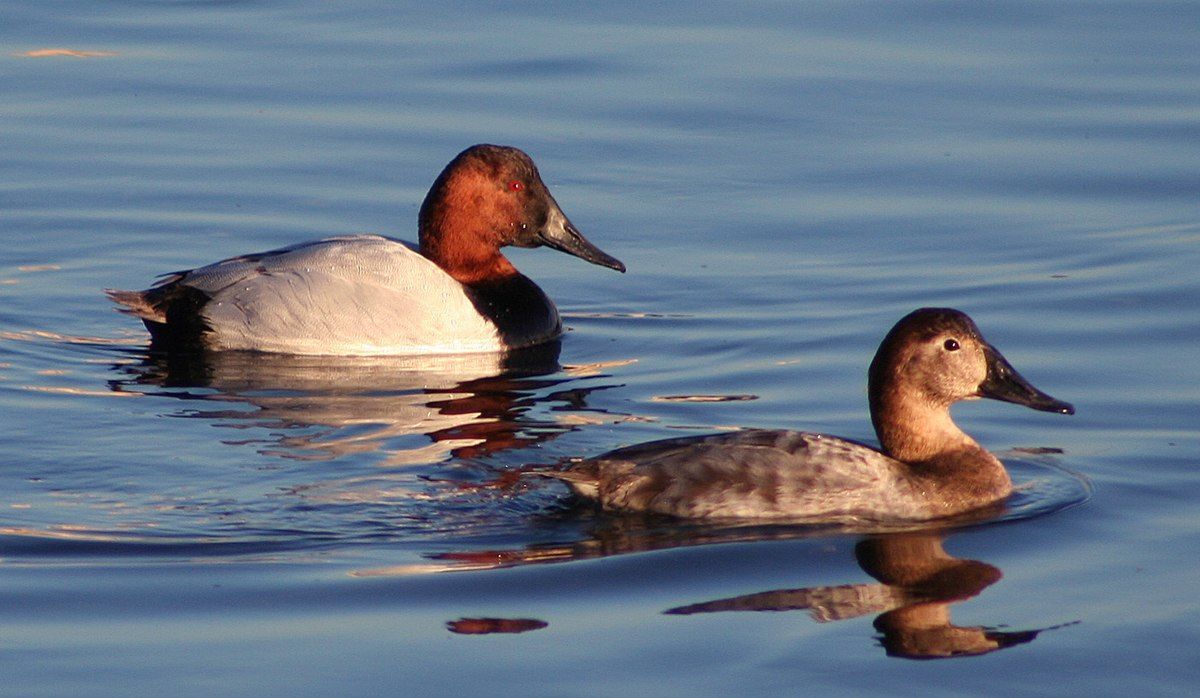
Holding the title of the largest diving duck in North America is the canvasback. They spend the migration and winter in large lakes and coastal waters where they can dive deep underwater to forage for their favorite foods, the roots and tubers of aquatic plants. The first thing you would notice about the canvasback is its unusual head shape which results from their foreheads having a heavy slope which blends into the sloping shape of the bill. The second noticeable feature would be the coloration of their bodies and wings which in males is a snow white and in females is a more gray or off-white coloration, giving the birds the appearance of a clean artistic canvas. Males have a black rump and breast while their head and neck is a reddish brown color. Females have a brown head and a more pastel or pale black on the breast and rump. Both sexes have a gray speculum on the wing though the eyes of the male are blood red while the females are black. Even though canvasbacks live through the entirety of North America the largest migrating population fly through the Mississippi flyway, giving you excellent opportunities to spot these birds at locations such as the Nygren and Pecatonica wetlands. Most of the time, canvasbacks are silent. When other Canvasbacks approach a feeding area, nonbreeding birds let out a wheezing call. Occasionally, females quack as they take off. Canvasbacks were once considered an aristocrat's delicacy with many banquets across the 1800s featuring the duck in their menus, as the wild celery that they ate gave them a sophisticated flavor.
Ruddy Duck
Oxyura jamaicensis
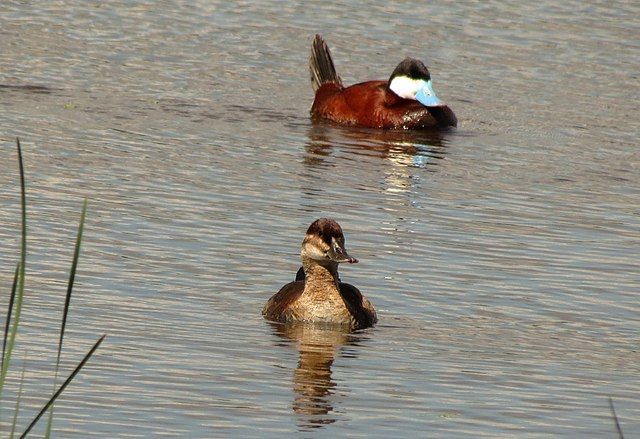
They are the only member of the stiff-tailed duck family that is native to North America, living across the continental USA, Southern Canada, Mexico, and the Caribbean. Like all other members of their family, the Ruddy ducks have long brittle tails features that make the tails stand erect while walking and swimming. This feature is the easiest way to tell them apart from all other local ducks. Ruddies are compact and stout only having an 18-inch wingspan and weighting a little over 1 lb. Males have a striking bright blue bill and a head that is white on the for end and cheeks but black on the backside and around the eyes. Their bodies are a chestnut brown with a gray-brown breast that resembles a granite countertop. Females have a brown-gray coloration throughout the body except for light off-white areas on the cheek. They do not have the blue bill but instead have a black one in which a brown strip erupts from; passing under the eye. Typically, Ruddy Ducks don't say much. The female hisses when threatened and uses a high-pitched cry to drive off lustful males in addition to her nasal call to attract her brood. The male makes a single call during courting displays that resembles a belch. To steal a peek at this spectacular species look for marshy and muddy ponds or lakes as these provide them with the most food and cover. Interestingly these birds show us a case of an American species being moved overseas and becoming invasive. They escaped from captive populations across the UK and Europe and threatened the existence of the endangered white-headed duck which they dominate and interbreed with.

RECENT ARTICLES