FIELD NOTES BLOG
July Bird Blog
July is here, the sun is hot, and even more birds are here to see!
If you enjoy Bird Blog, please let us know! You can always e-mail me at education2.americorps@seversondells.org or call 815-335-2915 and ask for Bryce!
Black-crowned Night Heron
Nycticorax nycticorax
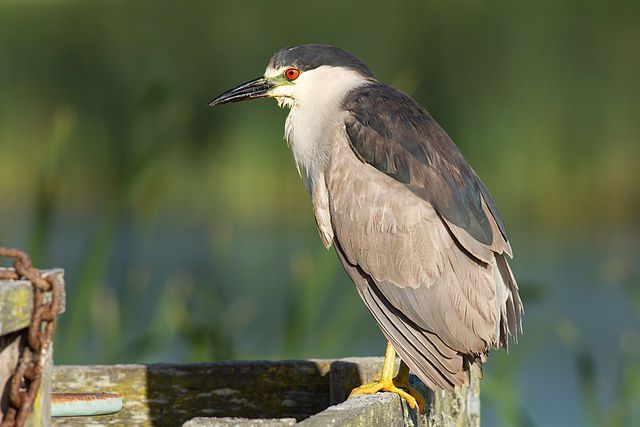
This heron is rather small when compared to the more well known species such as the great blue or the tricolored heron. Between the size of a crow and a goose with squat, thick proportions. This extends to their relatively short necks, board wings, and the heavy bills. These birds are not sexually dimorphic with all mature individuals possessing the same color pattern, though immature individuals look noticeably different. Mature birds have a white coloration from their face down to their abdomene, their flight feathers across the wings and tail are gray, their titular ‘black crown’ starts just before the bill and extends over the head down their back. Juveniles are far more drab, being brown all over with white spots scattered about. Something very interesting with their appearance is how their eye color changes with maturity, juveniles possess yellow eyes but as they age they become bright red. As their name suggests these birds are most commonly active at night; they emerge during evening and dusk to begin feeding on worms, fish, crustaceans, frogs and any other animals that can be found in or around water. Black-crowns migrate to our neck of the woods in order to breed, where they will form large nesting colonies of over a dozen breeding pairs being present. These are most notably found high in trees adjacent to bodies of water. One of the best places to see them is actually at the Lincoln Park Zoo where there is a rookery above the red wolf exhibit. Young will actually leave the nest at around 1 month old, which is strange given that they don't learn how to fly until at least 6 weeks of age. So for those 2 weeks after becoming independent they are forced to escape danger by using their feet to clamber through vegetation. Their call sounds similar to a raspy, bark-like squawk.
Barn Swallow
Hirundo rustica
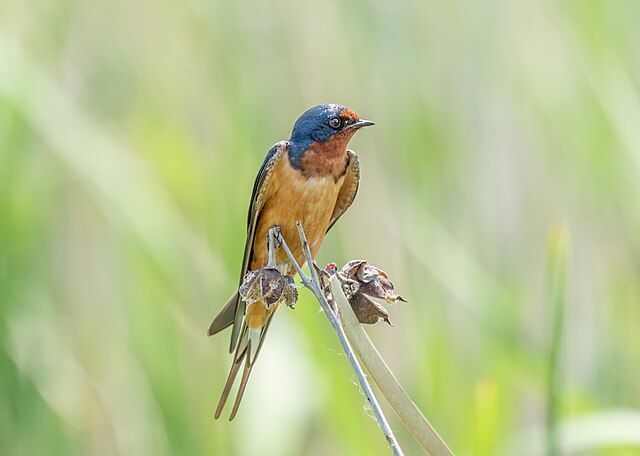
I don't think that anyone across the United States can truly say that they haven’t come across one of these birds. They are ubiquitous with human inhabited areas across the entirety of non-arctic North America and most of South America. Making them the most abundant and widespread swallow species in the world. These birds have traded in their ancient homes of cliffs and shallow caves for the relative safety of buildings and other human structures. Nests of dried mud, grass, and feathers can be seen under bridges, inside abandoned builds and even in the rafters of your very own porches and attics. Their coloration is simply spectacular: an iridescent cobalt-blue back paired with a tawny yellow belly and an orange-brown face makes this bird a true American beauty. The tail is broad and forked; dark in coloration and position a line of white spots. The wings are of a similar color minus the spots. Even though they are quite common they aren't something that you'll be seeing at your local feeders. This is because barn swallows are aerial feeders who catch insects while they are on the wing. The best place to spot them while not on the nest would be to look towards the skies at nearby fields, meadows, and bodies of water; for these are some of the most common feeding grounds for the birds. This bird holds a special place in conservation history as when the hat making industry caused declines in barn swallow populations led to George Bird Grinnell’s editorial essay, one that inspired the founding of the first Audubon Society. Both males and females sing the same song which includes a rapid bunch of mechanical sounding warbles.
Common Grackle
Quiscalus quiscala
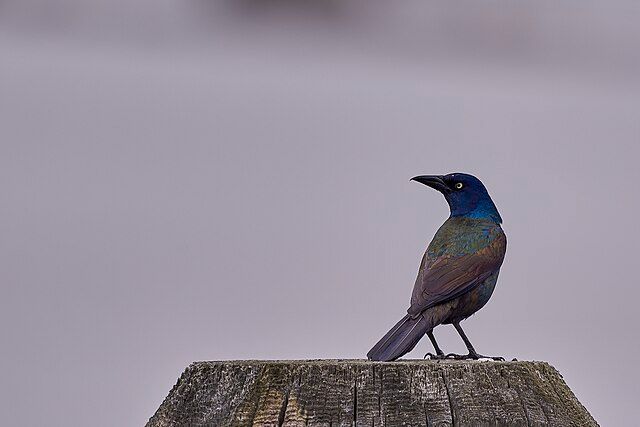
Colorful, kind of like oil, slicked and shimmering over black asphalt, is one of the best ways that I could describe the Common Grackle. This member of the blackbird family, as their name suggests, are quite common birds being found across a wide variety of habitats such as cities, farms, and open woodlands across most of the United States and Canada. They are taller and more slender than many other blackbirds and possess a proportionally long tail. Sexually dimorphic, the females are black and brown mix with slight iridescence in the feathers of the head. Males are far more spectacular with a blue-green iridescent head, and glossy olive-yellow body and a faint reddish-purple wings. Common foods for these birds include just about anything that is organic, from fruits to insects to human waste, with their favorite food being grains such as corn and rice. They are also highly gregarious, forming massive flocks. The 2 previously mentioned traits have led to serious human-wildlife conflict since birds can cause several hundred million dollars in crop loss when they descend upon some poor farmer's field. However, the common grackle might not be too common for much longer. Starting in the 1960s there has been a steady decline in their numbers with a nearly 4% decrease in their numbers. Most of this decline is attributed to changes in habitat as many of the abandoned fields and agricultural lands, their preferred habitat, are slowly being converted back into forest, a habitat they are not adapted for. If you would like to attract these birds to your property you can simply scatter seed and grain upon the ground, if they are in the area that should appear.
Like any other songbirds that possess a variety of call but their most common song is a high-pitched, guttural variety of squeaks, whistles, and croaks.
Chimney Swift
Chaetura pelagica
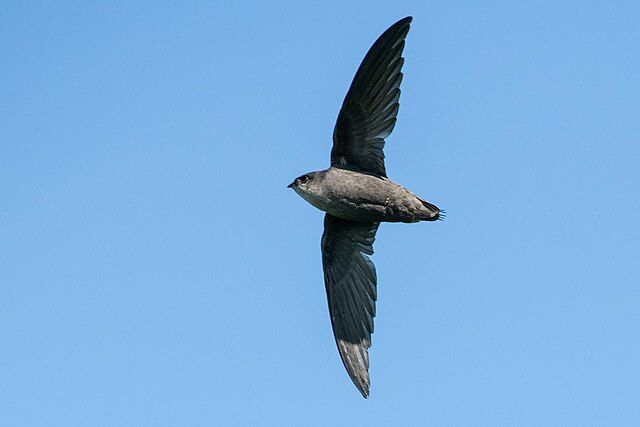
‘Its a bird… it’s a plane… no you were right the first time, it is a bird’. Specifically, it's a chimney swift. This bird is most commonly seen as a fast moving silhouette in the sky of cities east of the Mississippi, the shape of which is most commonly described as ‘flying cigar’. The title is given to it because its entire body is rather tubular in shape with a short neck, bear, and tail. Feathers are a dark, dusky brown save for a lighter gray patch on the throat and chin. The wings are rather long, especially when compared with the tiny size of their body, and end in a point, giving the overall wingspan look sharp and almost boomerang shape. Wingbeats are very stiff and shallow, similar to those of a dragonfly. These physical adaptations have made them excellent aerial predators, being able to catch flying insects such as mosquitos, moths, flies, and beetles high in the air with pin-point accuracy. Those of you who have houses with chimneys might hear the chorus of many birds tweeting their
fast-paced, high-pitched chips, which in some cases are only a half second apart resulting in an insect -like buzzing sound. And this is because, like the aforementioned barn swallow, this bird has become specially adapted to living in human inhabited areas. Chimneys are their preferred nesting sites for them since they emulate the dark areas with plenty of vertical surface area associated with their original natural sites such as caves and hollow old-growth trees. Vertical surfaces are required as the foot shape of the swift prevents them from perching like normal birds, they can only take off and land on walls and trunks of trees. Their nests are made from twigs woven together and glued together with saliva. Depending on the size of the chimney there can be up to 10,000 birds at one site, especially during the winter when they group up to conserve heat. Sadly, swifts like the common grackle have faced steep declines with 67% of the population dying off since 1966. This is most likely attributed to the fact that modern houses are not being built with the old-style brick chimneys. This coupled with the fact that natural sites have been destroyed for agriculture and housing has resulted with swifts losing most of their nesting sites, preventing successful breeding.
easter Whip-poor-whil
Antrostomus vociferus
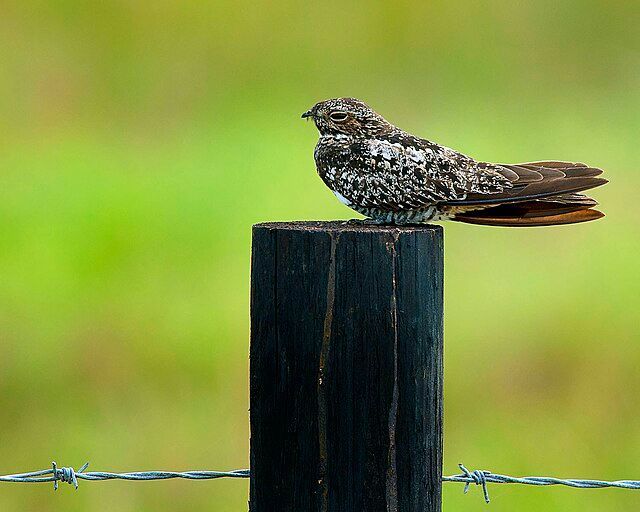
These birds have been made famous after being featured in a plethora of folk music and pieces of literature given their association with warm summer nights. Whip-poor-wills, like all other Caprimulgiformes, are nocturnal using their huge eyes to safely navigate in low light conditions. They are aerial feeders who, like the bar swallow and chimney swift, catch insects on the wing by scooping them up with their huge, cavernous maw and gulping them down. To help with funneling their prey into their mouths they have "rictal bristles; which are long, stiff and hairlike feathers that are present around the mouth that male their mouths ‘larger’ without actually having to grow a larger beak or head. These birds have narrow, rounded and disproportionately long wings which can be twice the length of the bird itself. During the day they are normally found resting horizontally perched on tree branches or on the ground. To aid in not being spotted by predators both sexes of the species are cryptically camouflaged with a complicated pattern of mottled grays, blacks and browns. Their bodies are rather squat poses round bodied and large heads and tiny legs. The only difference between males and females would be the presence of a white spot on the corner of the tail for males. Their call is quite easy to remember because it's just them constantly repeating their own names, ‘Whip-poor-will’, in an emphatic tone. These birds are far easier to hear than to see as the males will continue to call at dusk throughout the night for extended periods of time. If you do want to see them the best way is to use a red-spotlight to catch them resting on barren pieces of ground in open woodlands.

RECENT ARTICLES