FIELD NOTES BLOG
December Bird Blog
Ice . . . snow . . . wind chill, these are the terms that best describe the winter weather here in Rockford. On average we have 37 inches of snow each year and have the average high temperatures being 30 degrees Fahrenheit over the winter. I think that we all know how rough this type of weather can be on us, but at least we have access to shelter and technology to keep us warm- our bird friends don't have that luxury. Luckily many of the species that we know and love made the smart decision to migrate to warmer areas in the Southern States and in South America. That has resulted in a decrease in both the number of species and number of individual birds that we can regularly see. But for the ones we’ll be covering today, the cold doesn't bother them anyway. They spend their entire winter here no matter how much snow falls, how scarce resources become, or how hard the wind blows. They have behavioral or biological adaptations that help them survive in frozen areas.
Common Goldeneye
Bucephala clangula
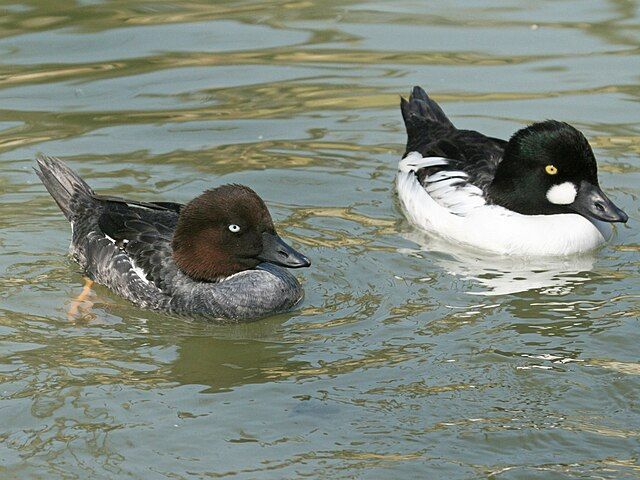
These are small arctic specialist ducks who spend their summers in the higher latitudes of Canada and Alaska. As more local duck species head to the Gulf Coast for the sun and sand, the common goldeneye comes in to take their place. As who would've guessed it, the 30-degree winters of Rockford are better than the negative 30-degree winters of the Arctic. The ice here doesn't get as thick on the inland lakes they love to inhabit, allowing them to still freely dive to consume crayfish and other aquatic invertebrates. The most easily discernible feature of this species would be their iconic gold-yellow eyes, which are easy to spot with binoculars at a distance. Adult males have a dark iridescent green and black head that plays host to a large white circle below the eye near the base of the bill. They have a dark black back that transitions into a bright white neck and breast. Females have a brown head without the white circle and have a primarily gray body. Both sexes have a noticeably ‘odd’ shaped head, which is quite large and has a sloped hump on its rear. Though the ones that visit Rockford in the winter have already completed nesting and brooding for that year, we are lucky to play host to the beginning of their courtship displays. As the winter progresses males will begin to perform complex “dances” where the males will touch their bums with their heads and then kick their feet forward, launching water into the air. Coupled with the physical display you might hear the males faint “peent” call. The wings of the goldeneye generate a whistling sound which has earned them the nickname “whistlers” by duck hunters.
Common Mergnaser
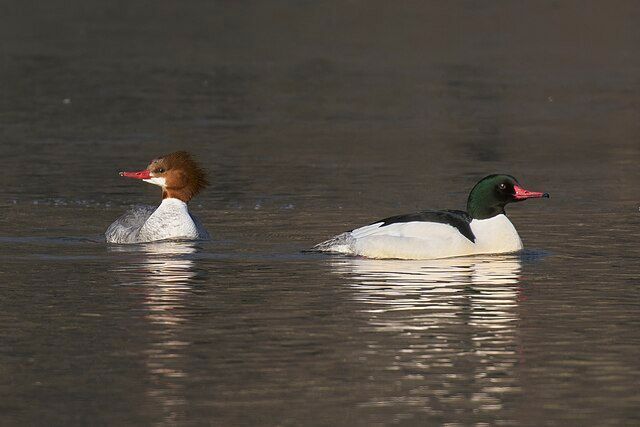
Another visitor from the far north, the common merganser, are often seen on large rivers, lakes and wetlands where they form very large flocks. The large flocks are regularly seen mixing together with flocks of common goldeneyes and buffleheads, which are both winter residents we've covered before. When looking for them on the water we are lucky because by this time of year they have molted and entered their breeding plumages. For males their bodies a white with a slight salmon tinge which contrasts their iridescent black-green head and and back. Females have overall gray bodies that lead into a reddish-brown head. Both species possess a red bill that, like in other mergansers, are thin, serrated, and end in a hook. Making them great tools for catching slippery fish. Both sexes also have a head crest but it's the females who you most often see displaying this feature as the males normally keep theirs slicked back over the tops of their heads, which is unusual for birds. They are quite large birds as individuals weighing up to 4lbs and can have over 3-foot wingspans. The sound you are most likely to hear them say would be the harsh ”gruk” call which is a response to a predator being in the area. As the season progresses the males will begin to sound off their display calls which are a hoarse twanging sound similar to a bell.
American Herring Gull
Larus aregentatus smithsonianus
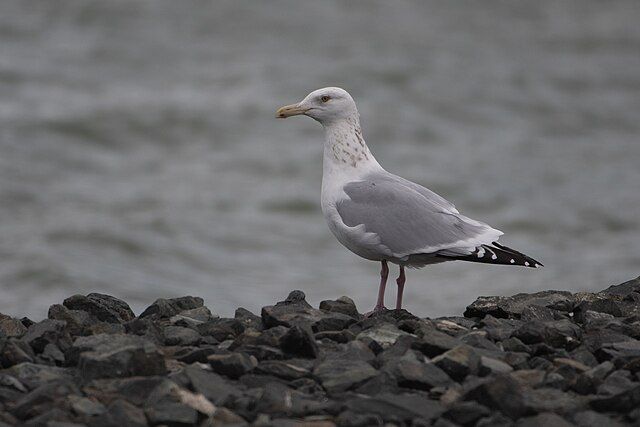
Something you can notice is that their scientific name has three parts unlike the numeral two, this is because it's a subspecies of the herring gull which also live in Europe and Asia. But, some believe that it is its own species called Larus smithsonianus, but the American Ornithological Society doesn't agree. You might just know them as “seagulls'' but they are so much more than that. Firstly the term “seagull” doesn't paint the whole picture of their habitat preference. They are found living in many aquatic natural habitats such as along rivers and lakes as well as oceans. But have also adapted to make their homes in more human-dominated areas like cities, garbage dumps and parking lots. During the warm summer months they spend their time catching fish, bird chicks, and small rodents across the Arctic. But come winter they take to the company of humans when they will return in flocks to the Rockford metro feasting on garbage, river fish, roadkill, and just about anything else. They are a relatively heavily built species of gull hosting a powerful bill and an impressive wingspan of up to 5 feet. You'll most often see them in flight where they can be identified by Their long, thin wings which are gray and end in a black tip. While grounded the birds are identified by their almost solid white bodies save for the gray and black of their folded wings and the presence of gray speckles on the head outside of breeding season. Immature birds are brown in coloration and will stay for up to 4 years. The most striking characteristic of the bird is their bright yellow bill that has a bright red spot on the underside of the beak’s tip. Their call is that iconic obnoxious laughing, which they'll use as a threat response along with various long shrieks and screams.
Peregrine Falcon
Falco peregrinus
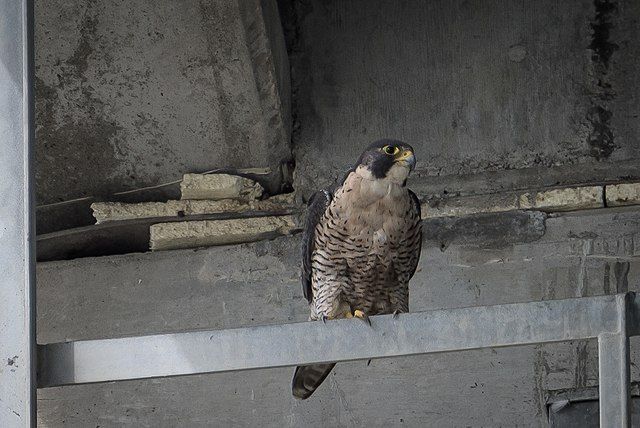
Holding the titles of not only the fastest bird on the planet, but the fastest animal on the planet earth, reaching speeds of up to 69 mph in flight and 200 mph in dives. It is also one of the most widespread bird of prey species, being present on every continent besides Antarctica, so it is no surprise that we have a resident population. It is often quite hard to catch a glimpse of them since they spend most of their waking hours high in the air surveying for prey, noticeably they love eating pigeons and waterfowl. If they aren't hunting they are perched high up on skyscrapers and other tall structures which simulate the mountains and cliffs that they would naturally nest on. But their appearance serves as the stereotype for what people think about when they hear the word ‘falcon’. Their breast and underside can range from white to tan and are barred with clean black bands. The wings and backside are dark brown to black in color which extends up to and around the head and face, creating a sort of “mask” or “helmet”. They have a bright yellow ring of skin around the eyes and have a heavily hooked beak which is yellow which fades into a dark gray-black. While in flight they have a sharp and gracile appearance as their 2 foot long wings both end in swooped back points; differentiating them in flight from hawks, eagles, and vultures. The call you'll most likely hear from them is a loud “kak, kak kak” which is used to alarm threats. Noticeably most peregrines in the area will actually migrate south for the winter but certain breeding pairs stick around through winter due to the city hosting a decent population of non-native birds like rock pigeons, starlings, and house sparrows. Many cultures across the world have also trained peregrines to hunt with them being partners similar to many hunting breeds of dog.
Pigeons
Columbia livia
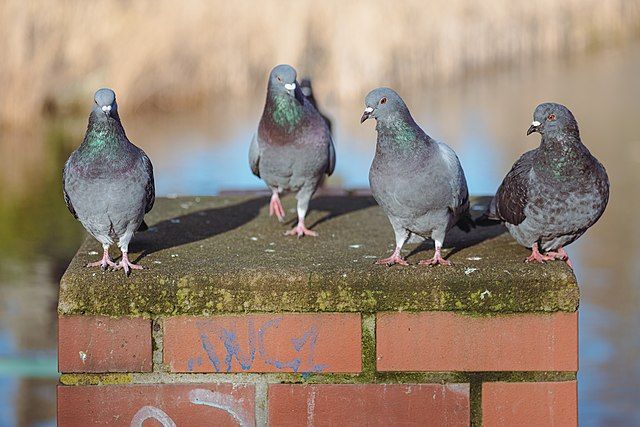
Even someone who has never left the concrete and asphalt of the city, they have to know at least one bird. That bird is none other than the feral pigeon, also known as the rock pigeon, rock dove, or common pigeon. They were brought over to the Americas from Europe along with the first explorers and colonists, who themselves received them from the peoples of the Middle East and India. They were originally domesticated to be used as food and messengers, but over the years a species culture was developed that revolved around breeding pigeons to have ornate colors, unusual body proportions, and fast speeds like we see in dog breeding. Selective breeding has resulted in a wide variety of appearances in the birds we see today. All of our “wild” birds are descendants of birds that escape captivity. Most pigeons still have the natural look which is a gray body that transitions to an iridescent purple, green, and blue head. Those with more exotic appearances can be completely white, red, brown, cream, black or any combination of those colors in a variety of different patterns. All individuals possess a knob-like growth over their nostrils. Their heads are quite small and have a short beak. Though thought of as city birds they can live in a wider variety of habitats as long as they are adjacent to human civilization. They are able to stay in Rockford year-round due to the constant supply of food provided by bird feeders and human garbage. Like other doves, pigeons' song and class sound like soft coos of varying lengths and tones. However, when alarmed they are known to grunt.

RECENT ARTICLES