FIELD NOTES BLOG
August Bird Blog
We are coming towards the climax of our warm summer days. In about a month the cold air will begin to sink into our city and drive many of our species away. But that time hasn't come yet, so we still have an absolute charcuterie board of bird species available for our viewing pleasure. And some of the best places to look for them are on the water; because just like you they are looking to make the most of that resource before it freezes over in the coming months.
Belted Kingfisher
Megacercyle alcyon
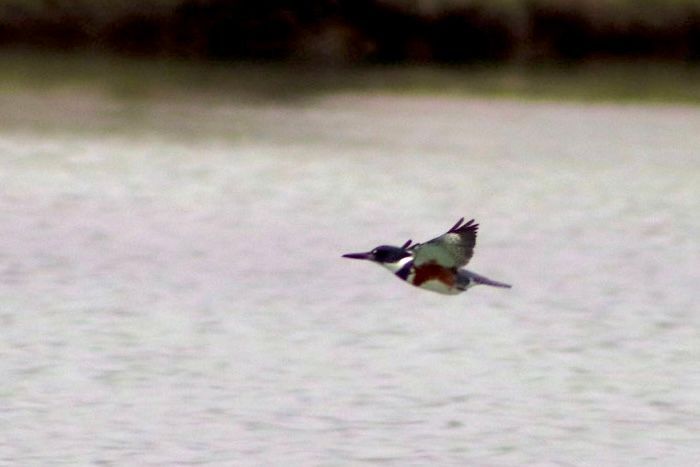
That's not a funky-looking blue jay you're seeing, that's the belted kingfisher, though I couldn't blame you for thinking that due to their similarities. The first similarity you can notice is in the coloration, like the blue jay, the kingfisher has a trichromatic, 3 color, patterning with white coloration on the breast and neck, blue-gray coloration on the back and head, with black barring on the tail. This species holds the title of the United States only species of kingfisher. Differences between the birds lie in their bodily proportions. Kingfishers have longer and heavier beaks than blue jays, needed for dispatching their prey. The beak sits on a massive head, one that is almost disproportionately large for their body size. Their heads are host to a large erect crest of blue-gray feathers, which are both larger and taller than that of a blue jay. Their namesake feature is their belt, or in females their belts, which is a band of blue feathers that wrap around the upper breast. In females, they have a second belt of rusty red-brown feathers that wrap around the lower breast. They are a piscivorous, fish-eating, species of bird that specializes in catching its prey using a tactic called aerial diving. Here a bird will stay perched near a body of water and survey the area, upon spotting prey they will take to the skies then dive head first into the water to seize prey. Though they are primarily fish eaters they will also prey upon amphibians, crustaceans, small reptiles, small mammals, and other birds. Unlike most other birds they actually nest inside underground burrows, normally on the sides of cliffs or steep river banks. Both sexes of the birds let out loud mechanical rattles and screams. The best places to catch them in Winnebago County would be along the clearer waters of the rivers or at our very own Severson Dells Pond.
Double-crested Cormorant
Nannopterum auritum
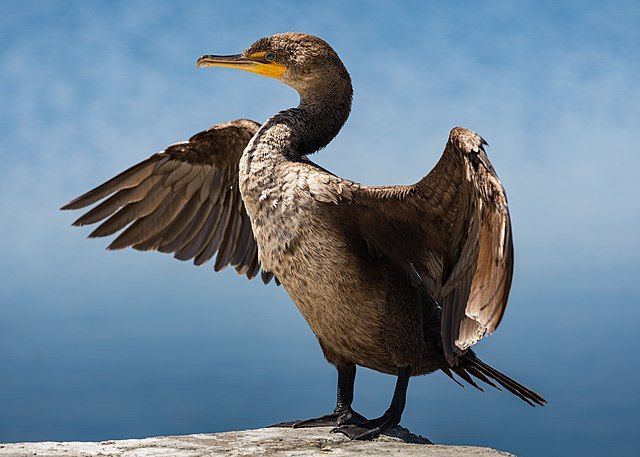
If you are on the water and see a gangly black bird soaking up rays along the beach or standing on the tree or post; you’re in the presence of the double-crested cormorant. The reason for this behavior is because, unlike every other waterbird, they lack the oils in their feathers required to become completely waterproof. Which is quite problematic since they have to dive underwater to swim after fish. Some scientists believe that having water soak into the feathers actually makes them more agile underwater, but it's a trade-off as they must spend time drying off in the sun before being able to fly. The lack of oils on the feathers also results in their feathers not having any sort of shimmer or sheen, resulting in a matte black coloration across the whole body. The only part of their body with any color would be the mask of bare, orange skin that covers their face. Set into this mask are two eyes, blue, like polished sapphires. Their beaks are long and hooked, like if someone stretched out a hawk’s, and they have a long S-shaped neck. During the breeding season, adults will grow a crest of feathers above each eye, giving them the appearance of a frazzled, balding gentleman. They are a conservation success story, as they became very rare in the 1900s due to DDT. Following the ban on DDT coupled with an increase in fish farm abundance since the 1970s their populations have been allowed to absolutely explode. The population has reached such critical levels that it is not uncommon to see huge flocks even around small or poor water bodies. They are also a likely culprits aiding in the decline in the decline of sportfish such as bass and trout since they can eat several large adult fish every week, prompting concerns from the Fish & Wildlife Service and Fish farmers across the country. Common places to see Cormorants would be along any large body of water such as Rock Cut State park, Rock River, and Pecatonica Wetlands. Just keep an ear out for pig-like grunts from birds that are taking off or landing on the water.
Great Egret
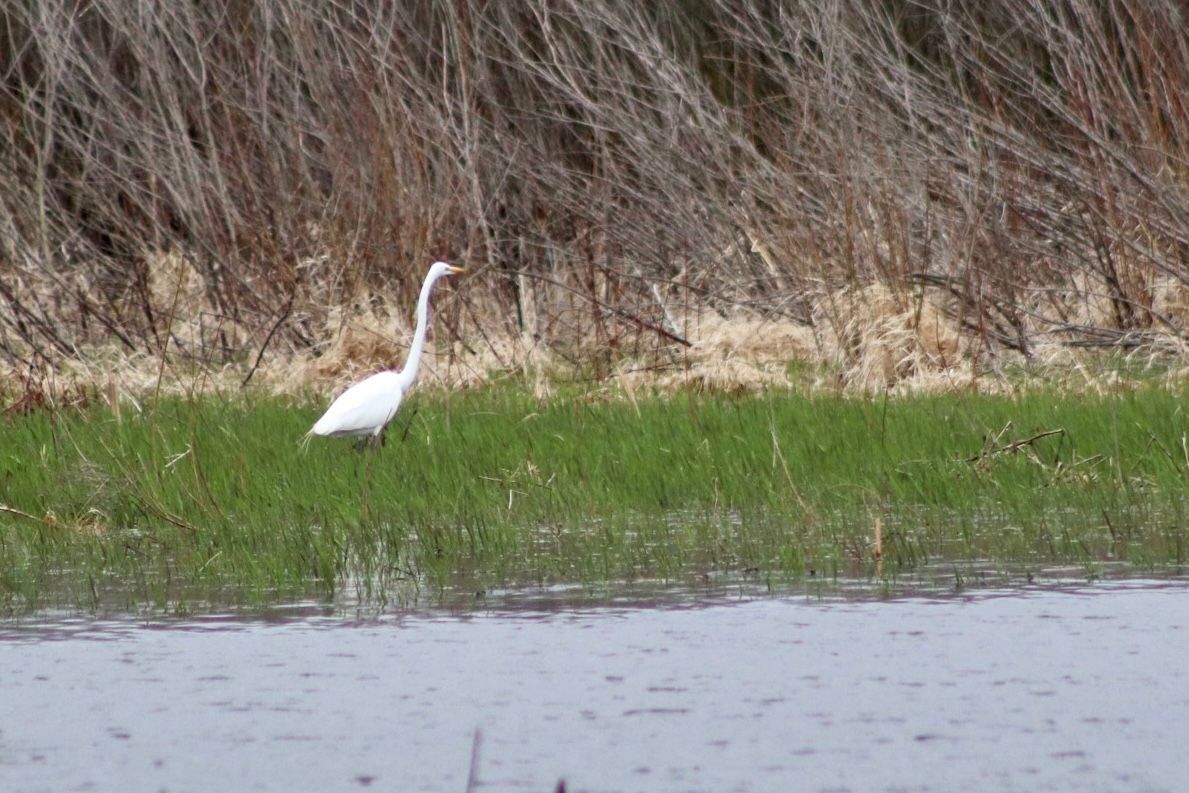
A dazzling sight to behold like a snowflake in summer, the great egret stands out and steals the spotlight from other creatures on the water. These birds share a number of features with great blue herons, including long skinny legs, and long snake-like neck, and a heavily pointed bill for catching fish. The things different between them would be color and the egret’s lack of a head crest. Differences only increase in the breeding season as the adults of both sexes will grow absolutely massive spindly plumes of feathers. In flight they will look identical to a great blue heron with the folded neck, but just in all white. These birds are found across 5 of the 7 continents, where they will inhabit any body of water they can find. You will see them either standing still or slowly stalking across the water searching for fish, amphibians, crustaceans, and small mammals. The call of the great egret is a dry, raspy croak which they will par with the rapid clacking of their bills and loud, nasally squeals. We are lucky to have great egrets in our areas today because this bird was facing extinction in the 1800s and 1900s as there was an international hunting industry for these birds as the rich and powerful wanted to turn their breeding plumage into hat decorations. Thankfully the Audubon Society stepped up to protect this species and many like it from the feather trade; it still serves as their mascot to this day.
Osprey
Pandion halioetus
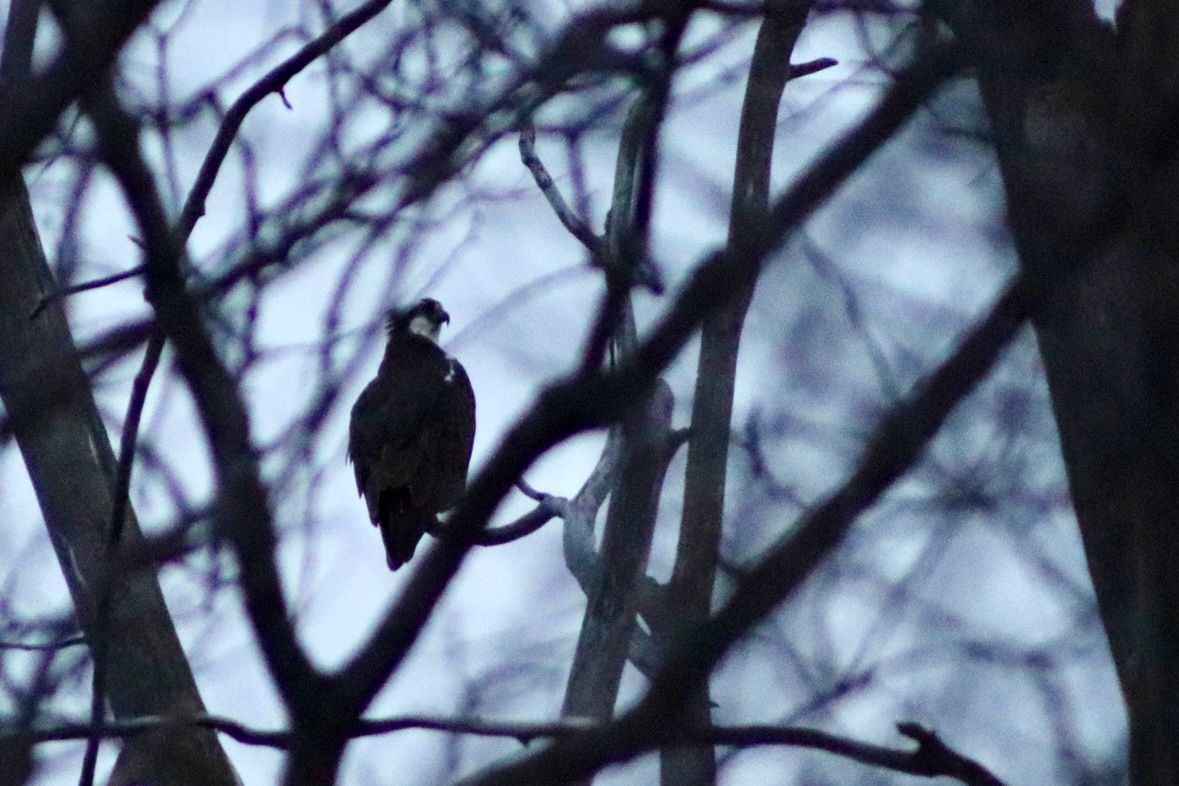
One of our region's most unique birds of prey as they are the most specialized of the fish-eating raptors, garnering them their titles of “sea hawk”, “river hawk” and “fish hawk”. Amongst their specialized physical features would be their distinct bill that has a proportionally longer hook than other raptors which makes it perfect for cutting into the scaly skin of fish. While most other raptors have some sort of cryptic coloration or camouflage; the coloration of the osprey is quite striking but simultaneously bland. Most of their bodies; including the legs, breast, and neck, are white. While the bird's backside, wings, and eye mask are chocolate brown. It's important to note that the osprey is not as heavily barred as other birds of prey. Ospreys are on the large size of our soaring birds, easy to distinguish in flight as their wings are long and sharper than those of bald eagles and the forest hawks, like red-tails and broad-wings. To further discuss their fishing specializations we need look no further than their feet. They have very long talons, but these are only compliments to the special toe pads they possess that stick to fish scales like Velcro. Their feet are also so dexterous that they are able to manipulate and rotate fish while in flight; this skill is what allows them to fly off with extremely heavy fish as they always point them in a direction to increase the fish’s aerodynamics. They are very adaptable nesters, being able to make their homes in any area near water that has a sufficient food supply. The best place to view ospreys would be at Rock Cut State Park, Blackhawk Springs Forest Preserve, and Kishwaukee River Forest Preserve where they have been recorded returning to nest over the past few years. Ospreys whistle in a high-pitched voice. Their sounds can be a slow series of chirps made while in flight, or they can be combined to produce a series that intensifies and then fades, like the sound of a kettle quickly removed from the stove.
Tree Swallow
Tachycineta bicolor
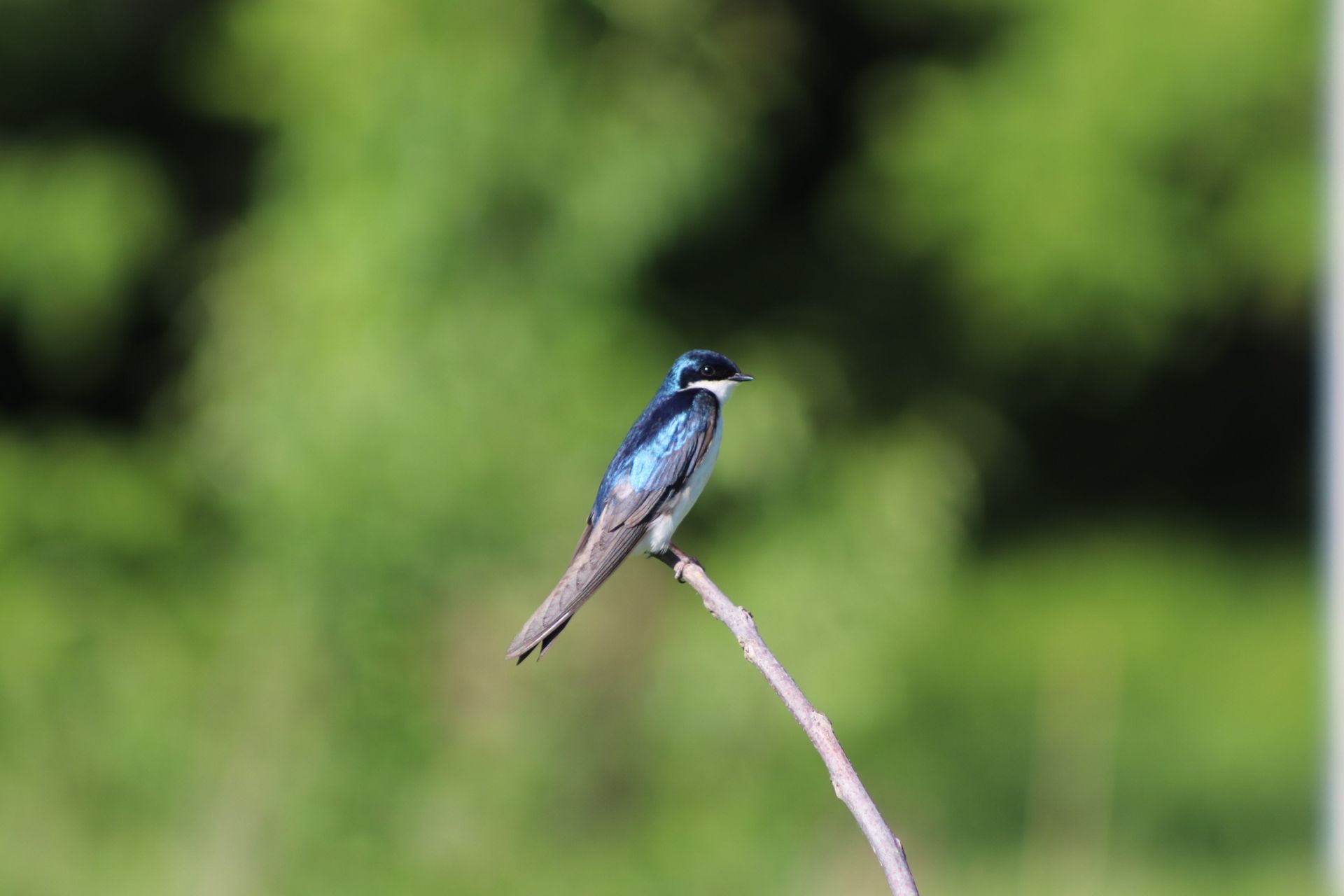
Though they may not seem like it, these birds similar to the other 4 covered this month in that they can be often associated with bodies of water. During the breeding season and summer months, tree swallows make their homes in open woodlands, especially those that are near permanent bodies of water. Lakes, rivers, and wetlands provide them with plenty of places to roost and stable populations of their preferred food; flying insects. This is because many insects start their lives as larvae underwater but emerge throughout the summer. The species name, bicolor, means two colors which is quite humorous given that these birds actually have three colors present on their plumage. From their chins and cheeks down the breast to the rump, they are completely white. The tops of the head, the shoulder, and the upper back are all a shimmering blue. The edges of the wings and the entire tail are a charcoal gray color. This species is not sexually dimorphic, so males and females will look identical. Immature birds have a more off-white coloration on their undersides while their backside, tails, and wings are all a blend of charcoal gray with a tinge of iridescent green-blue. In flight, their shape is fairly indistinguishable from other swallows, besides the barn swallow. They have a tubular body that is supported by a pair of very triangular wings. This time of year is the start of the wind-down period for these birds in this region. With this year's chicks finally having the know-how and physicality to take flight, it's time for them to start their migration. They'll still be around the area for a little while longer as they will need to fatten themselves up on insects before they head to Florida, Cuba, and Mexico for the winter. If you were to look towards the skies directly over the rovers and lakes here in Rockford you are almost certain to see them scooping water and catching insects. Bluebird boxes also inadvertently attract tree swallows as they mimic the tree cavities they naturally nest. Songs are a high-pitched trio of chirps, whines, and, gurgles made by males and females. They also have normal calls which are aggressive chatters and chirps.

RECENT ARTICLES